
Problem Statement
Ulaanbaatar faces a critical shortage of accessible green space. As of 2022, the city’s per capita green space is only 5.1 square meters, which is half of the minimum level recommended by the World Health Organization. This deficit is not evenly distributed across the city.
More than half of Ulaanbaatar’s population lives in ger districts, where access to public green spaces and basic urban amenities remains severely limited. These areas are characterized by rapid urban migration, low-density housing, and underdeveloped public infrastructure. While residents rely heavily on shared facilities such as water kiosks for daily survival, these spaces are purely functional and offer no opportunity for social interaction, recreation, or environmental relief.
The lack of green and shared public spaces in ger districts contributes to reduced physical and mental wellbeing, weak social cohesion, and heightened vulnerability to climate risks such as heat, flooding, and air pollution. Despite these challenges, water kiosks remain one of the most frequently visited public spaces in ger areas, serving ~44 households daily per kiosk. Their ubiquity represents a missed opportunity to address environmental and social challenges using existing, trusted infrastructure.
Project Overview
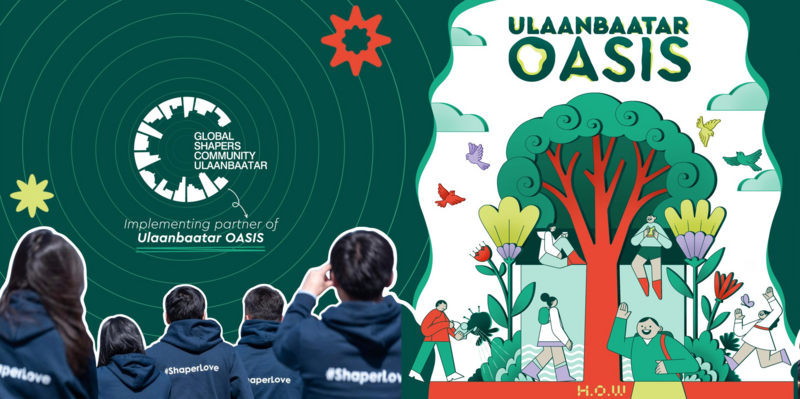
Ulaanbaatar Oasis reimagines urban space by transforming water kiosks into green, multifunctional pocket parks that serve as social, environmental, and community hubs. Implemented in partnership with the Gonchigsumlaa Foundation and H.O.W Architecture, the project offers a low-cost, community-driven solution to increase equitable access to green space in underserved ger districts.
Ger districts are a unique urban landscape where families live in both traditional Mongolian gers (yurts—mobile dwellings) and permanent houses. While these communities have strong social ties, they lack shared public spaces. Ulaanbaatar Oasis builds on existing community dynamics by upgrading everyday infrastructure into inclusive public spaces that strengthen social connection while improving environmental conditions.
Impact to Date
In October 2023, Ulaanbaatar Oasis launched its first pocket park in the 31st khoroo of Bayanzurkh district, converting a neglected 401 m² area into a vibrant green public space. The launch was marked by a community tree-planting event involving local residents, during which over 70 trees were planted.
Co-funded by the Climate Reality Project and the Gonchigsumlaa Foundation, the pilot demonstrated how collective action and nature-based solutions can successfully rejuvenate underused urban land in low-resource contexts, while fostering community ownership.
Next Phase (Ongoing)
Building on the success of the pilot, Ulaanbaatar Oasis team members are working on implementing more pocket parks in a ger district with support from the Youth4Climate initiative by the United Nations Development Programme (UNDP) Rome.
Each water kiosk serves ~44 households daily per kiosk, making this intervention a direct and consistent touchpoint for neighborhood engagement.
We are working on following end-to-end implementations:
- Innovative pocket park architectural design adapted to ger district conditions
- Construction oversight and quality assurance
- Government permitting and coordination
- Community engagement and co-creation
- Public awareness and education through social media
To ensure long-term and scalable impact beyond a single site, the project will also deliver:
- One practical user manual documenting step-by-step guidance for building green pocket parks in low-resource contexts
- A neighborhood education program focused on pocket park maintenance, tree care, and shared community stewardship
This phase formalizes the project into a replicable model, combining physical infrastructure with knowledge transfer and capacity building.
Long-Term Vision
In 2024, Ulaanbaatar Oasis officially registered as a non-profit organization in Mongolia. In the long term, the project aims to expand beyond Ulaanbaatar—and beyond Mongolia—by advocating for pocket parks as a standard component of urban development in cities where green space remains inaccessible.
With approximately 9,000 government-owned water kiosks across Ulaanbaatar, even partial replication represents significant potential for city-wide impact. Through documentation, education, and policy advocacy, Ulaanbaatar Oasis seeks to normalize community-driven green infrastructure as a foundation for healthier, more inclusive, and climate-resilient cities.
Social Media Reach & Community Engagement
Ulaanbaatar Oasis actively builds awareness, mobilizes volunteers, and shares educational content through social media. We highly encourage you to visit our instagram and watch the video we made changes to neighboring child life and more.
Instagram: 1,220 followers, 33 posts (2026 Feb 3)
https://www.instagram.com/ulaanbaatar.oasis/
Facebook: 411 followers (2026 Feb 3)
https://www.facebook.com/profile.php?id=100089219299954
Impact videos:
About what we did:
https://www.instagram.com/p/C7wG4o7h3G5/
About How UB Oasis impacted Temuulen boy's life:
https://www.instagram.com/p/C7ypJzth889/
About How UB Oasis impacted Galtmaa's life:
https://www.instagram.com/p/C8rMAEnxEZP/
About How UB Oasis impacted Jargal's life:
https://www.instagram.com/p/DJturXfNN9D/